
Hardin County Release and Supervision Scope
A status check should preserve the sequence of events. The Hardin County Sheriff record answers when the local booking ended. The sentencing court answers what legal order applied. CSCD or TDCJ then answers whether community supervision remained active. These sources can all be correct at the same time even when their dates differ. For example, a person may bond out before a later dismissal, finish a county booking but transfer to state custody, or leave TDCJ on parole while the sentence continues outside prison.
Use each record only for the fact it owns. Ask Sheriff Records for the public booking and release sheet when release type or destination matters. Ask the correct clerk for the filed judgment, probation order, modification, revocation, or discharge. Ask TDCJ for the release certificate or incarceration history in a state case. This source-by-source method is more reliable than treating a roster, notification, or court calendar as a universal post-release record.
Hardin County Parole vs Probation
Parole and mandatory supervision follow release from a Texas Department of Criminal Justice prison. The Texas Board of Pardons and Paroles decides release and many conditions, while the TDCJ Parole Division performs day-to-day field supervision. Probation, called community supervision in Texas law, begins with a court judgment and is administered locally by the Hardin County Community Supervision and Corrections Department. A person who posts bond may have bond terms, but that alone does not place the person on parole or probation.
| Question | Parole or mandatory supervision | Probation |
|---|---|---|
| Who orders it? | BPP acts within the state sentence and release process. | The sentencing court enters the community-supervision order. |
| Who supervises it? | TDCJ Parole Division, with Hardin County mapped to Beaumont. | Hardin County CSCD in Kountze. |
| Best starting record | TDCJ detail, BPP result, and release certificate. | Filed judgment and later court orders. |
| Best proof it ended | TDCJ discharge or incarceration history. | Filed discharge order, supported by CSCD confirmation. |
Definitions. Parole and mandatory supervision continue a state sentence outside prison; probation is a court sentence served under community supervision.
These labels matter because one portal cannot answer all three questions. The TDCJ offender search is not a public Hardin County probation roster. Likewise, a local probation office cannot certify a BPP vote or state release certificate. Identify the sentence type before calling an office.
Verify Hardin County Post-Release Supervision
Begin with an identity match and the order that created the status. Do not infer supervision from a person’s absence from the Hardin County Jail current roster or presence in the DCN RELEASED grid. That grid confirms that a county booking ended, but it does not state whether state parole, probation, a transfer, or no supervision followed.
- For a felony or misdemeanor probation case, obtain the judgment and any modification, revocation, or discharge order from the correct Hardin County clerk.
- For a state-prison case, search the TDCJ offender search by TDCJ or SID number when possible, then read the exact parole-review and release-date labels.
- Check the individual BPP result. An FI vote supports approval, but it is not proof that the person left prison.
- Confirm actual state release through a release certificate, incarceration history, or TDCJ status response. Then verify the assigned parole office.
- For probation, contact Hardin County CSCD only after the court record establishes community supervision. Ask what nonconfidential status or discharge information can be supplied.
A no-result does not prove discharge. The record may be old, identifiers may differ, or the person may be outside that system. TDCJ’s free email channel can return incarceration history and projected-release information when an online detail no longer appears. A durable verification keeps the source URL, lookup time, exact field label, identifying number, and an agency or certified court copy.
Note: A county Release Date establishes the end of one booking, not the start or end of supervision.
Hardin County Supervision Has Two Offices
Hardin County’s supervision geography is unusually clear. Probation is local at the courthouse in Kountze. State parole coverage is regional and points outside the county to the Beaumont District Parole Office and District Reentry Center. The split mirrors the legal source of each status: judgment plus CSCD for probation, and TDCJ plus BPP and Beaumont for parole.
Hardin County CSCD / Adult Probation
Courthouse, first floor west wing
300 Monroe Street, Kountze, TX 77625
P.O. Box 237, Kountze, TX 77625
Phone: 409-246-5170
Fax: 409-246-8110
The official Adult Probation page identifies Kevin Cummings as director/chief. No general public person-by-person probation search was found. The court file is therefore the sound first step, followed by the CSCD for the reporting-office path or confirmation it can lawfully provide.
Beaumont District Parole Office / DRC
1780 West Commerce Parkway
Beaumont, TX 77707
Phone: 409-835-9981
Fax: 409-868-4503
The TDCJ county cross-reference maps Hardin County to Beaumont. Ask whether Beaumont is the correct public status contact for the named releasee. Do not expect a precise home address or protected case notes to be released.
The official Hardin adult-probation page shows the local side of this split.
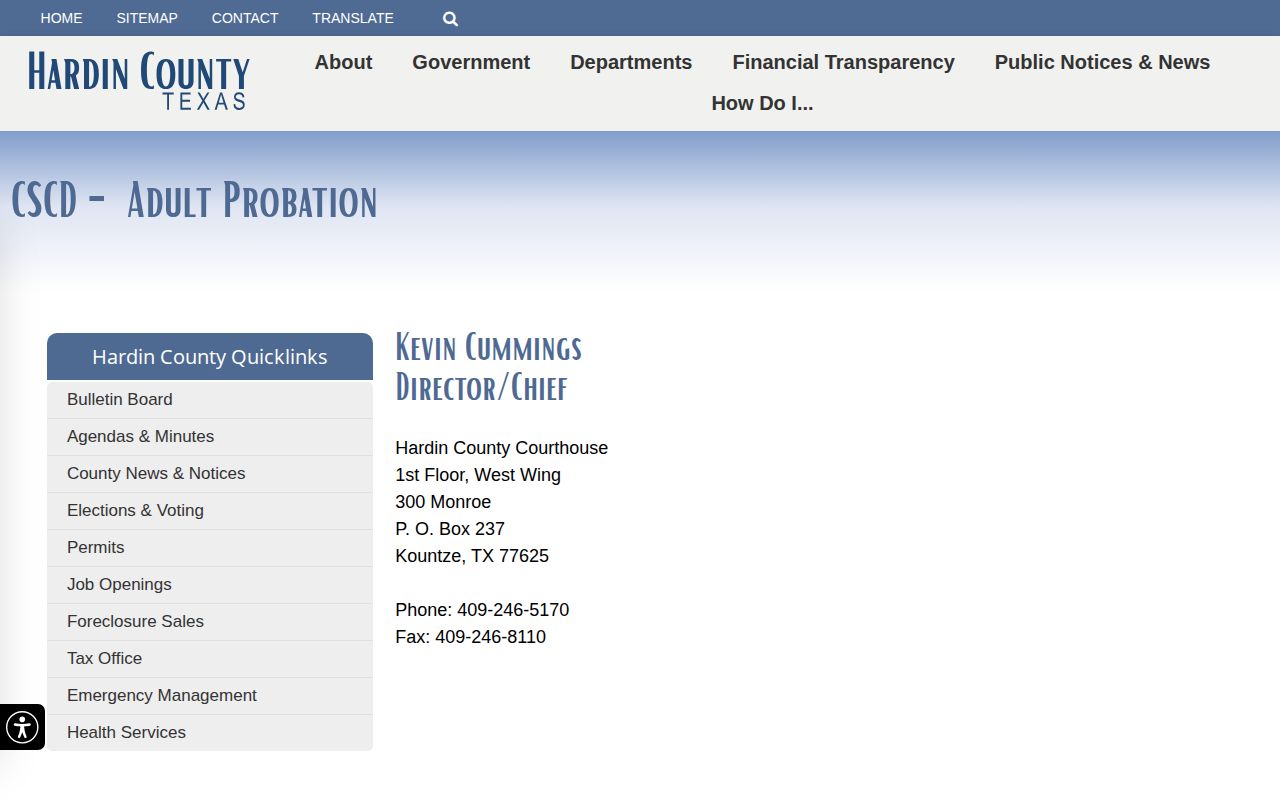
The image helps distinguish the county probation office from TDCJ’s regional parole network.
Hardin County Parole Release Process
A BPP review is an administrative file review, not proof of an exit. For a TDCJ person, read the full vote code and its date. FI-1, FI-2, and program-conditioned FI results do not have the same operational effect. Review and Release Processing still checks the release plan, address and county-of-residence rules, required programs, disciplinary issues, special conditions, and other criteria before a certificate is issued.
After favorable action, check Scheduled Release Date and Scheduled Release Location on the current TDCJ detail when those fields appear. TDCJ warns that a scheduled date can change without notice, including on the stated day. The Hardin County Release Date Lookup explains the projected, scheduled, and actual stages in more depth.
The official BPP vote-options page illustrates why the whole code matters.
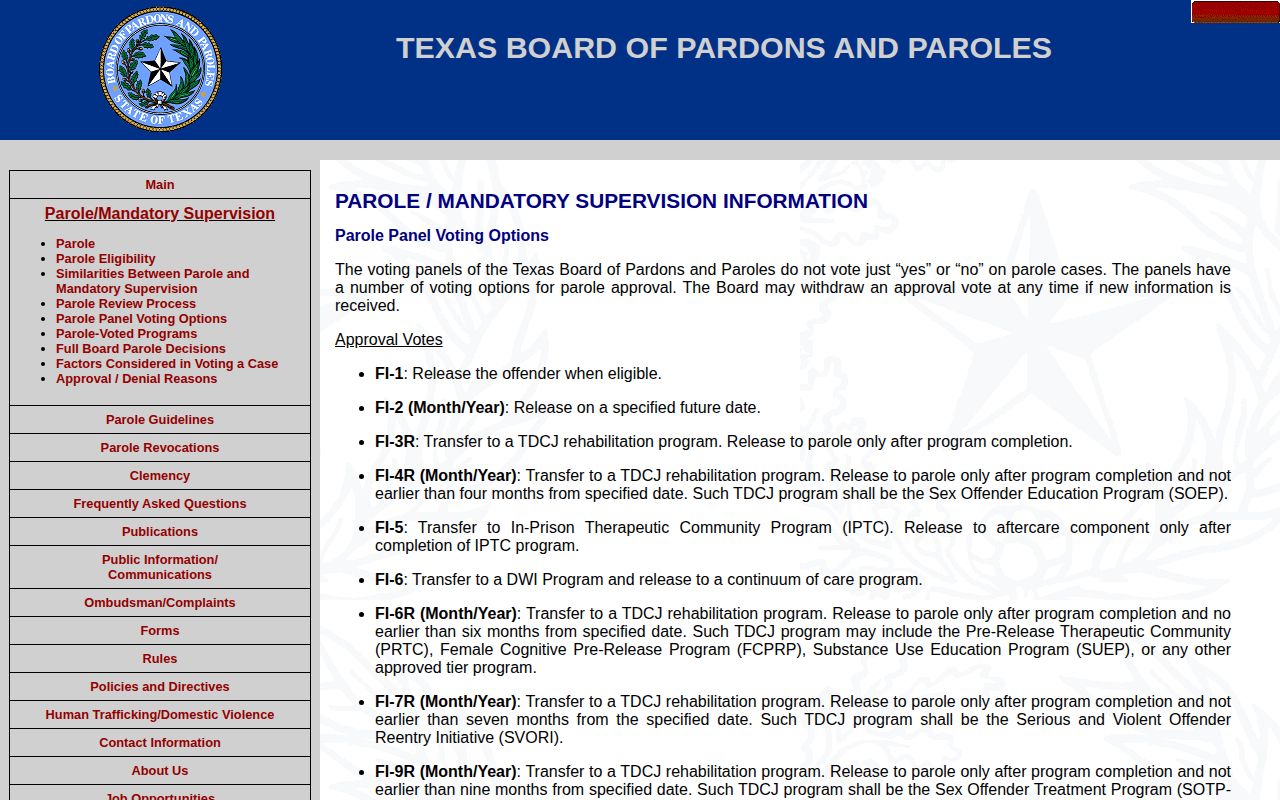
Use the displayed decision as one step, then obtain actual-release evidence and the assigned supervision office.
Once released on parole or mandatory supervision, the person remains under sentence conditions. Flat discharge is different: it completes incarceration and associated state supervision. A release certificate is primary proof of supervised release, while a TDCJ discharge or incarceration-history record is stronger evidence that the state sentence ended.
Hardin County Conditions and Violations
Conditions depend on the individual order. Common categories can include reporting, travel limits, program participation, fees, residence rules, or special conditions, but the exact certificate or probation order controls. Do not substitute a general summary for the signed document. For probation, later modification and revocation filings belong in the sentencing court’s file. For parole, TDCJ and BPP records document the applicable state process.
A missed report or an online no-result does not justify calling someone an absconder. TDCJ maintains a sex-offender absconder search, but it is narrow and is not a general list of parole warrants or every person alleged to have violated supervision. Confirm a warrant, revocation, or absconder designation with the responsible authority.
If a person is arrested again, separate the new booking from the earlier supervision record. The Hardin County DCN row can document the new admit and release event, while the parole certificate or probation case explains the preexisting status. A transfer to another custodian can end the Hardin booking without returning the person to the community.
Hardin County State Release Notifications
Texas uses more than one notification layer. VINELink serves participating custody feeds and should be searched by the correct person and agency. TDCJ’s Integrated Victim Services System is separate and can cover state custody, parole, and mandatory-supervision events, including parole eligibility, BPP decisions, discharge date, and release. IVSS support is available at 800-848-4284.
The official TDCJ IVSS portal is the state-specific notification route.
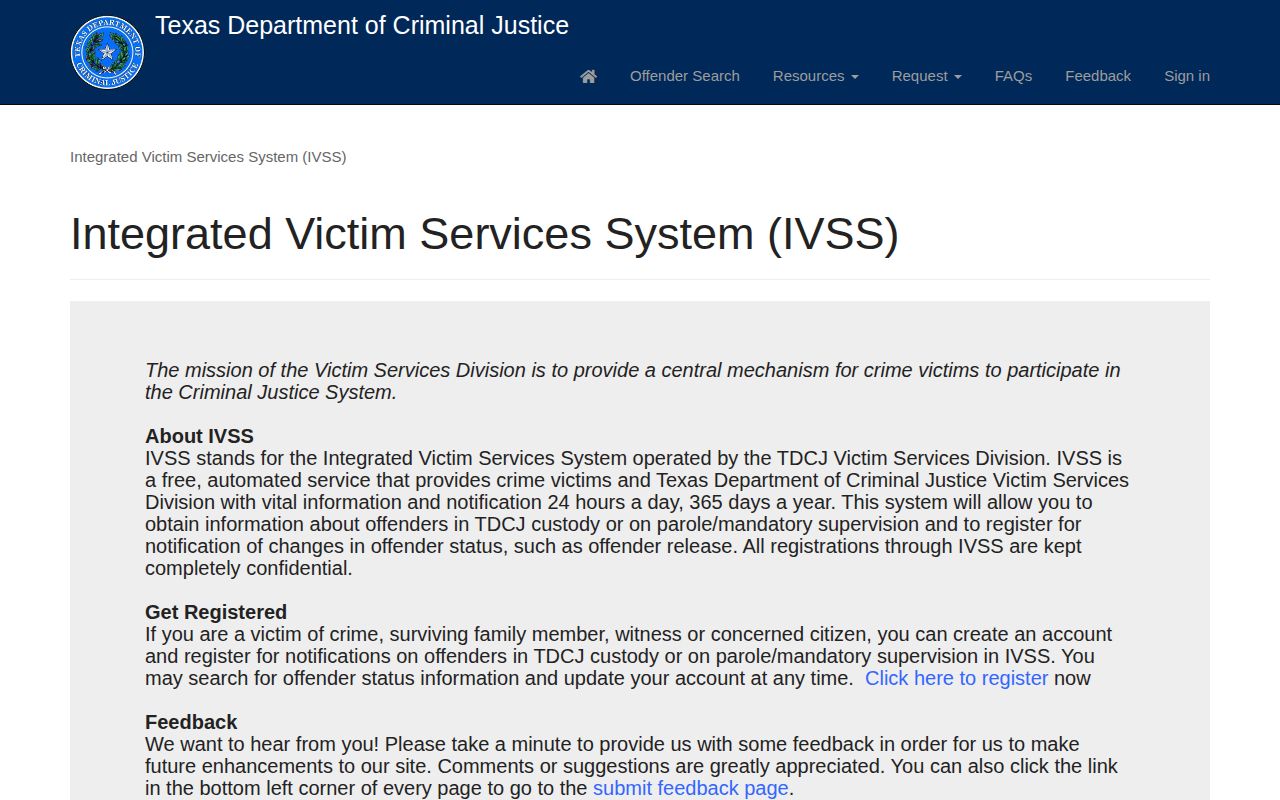
This separate state layer prevents a county VINELink record from being treated as a complete parole history.
Notifications are useful for alerts, but they are not certified proof. Compare the agency name, event time, and identifier to the source record. If an alert conflicts with a Sheriff or TDCJ record, save both and ask the source agency to reconcile the data feed.
How Hardin County Supervision Ends
For probation, the durable sequence is the judgment placing the person on community supervision, any later modifications or revocation filings, and the filed discharge order. Hardin County CSCD administers the term, but the sentencing court’s filed order is the best public evidence that it ended. Completion of probation is not release from prison when the sentence was served in the community.
For parole or mandatory supervision, use the TDCJ release certificate for the beginning of supervision and an incarceration-history or discharge record for completion. “Discharge” means the person has completed the sentence and associated supervision under TDCJ’s definition. An old projected date, a favorable vote, or an inactive online result is weaker than the agency record.
The felony file is kept by the Hardin County District Clerk for the 88th and 356th districts. County misdemeanor matters go to the County Clerk. A public docket PDF is a calendar, not a final discharge order. The broader Hardin County released-inmate guide explains how to pair the court file with the jail Release Date.
Verification rule. Use the court discharge order for probation and the TDCJ discharge record for state supervision.